Standard Residential Lease Clauses Explained (With Examples)
Every clause a residential lease should include — rent, deposit, late fees, quiet hours, and material breach — explained in plain English with example wording.
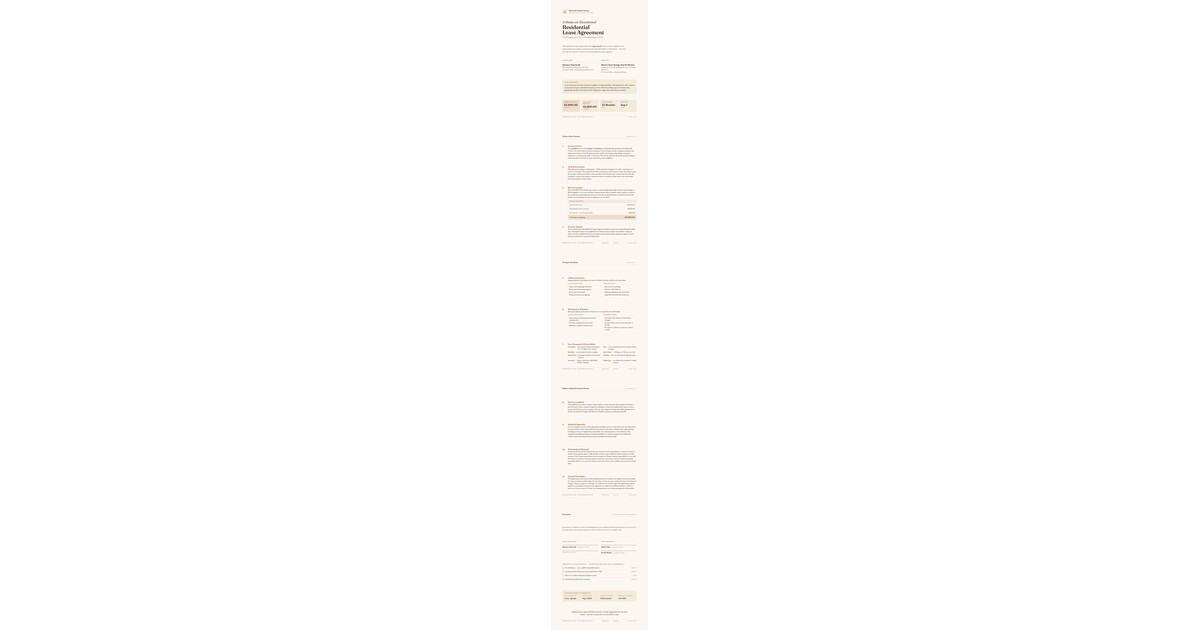
A residential lease agreement should spell out, at minimum: the parties and property, the term and rent, the security deposit, late fees, maintenance responsibilities, quiet-hours and quiet-enjoyment rules, entry notice, pet and subletting terms, and what counts as a default or material breach. Get those clauses right and most landlord–tenant disputes never happen — because the answer is already written down.
Below is a plain-English walkthrough of every clause a standard residential lease should contain, with example language you can adapt. (This is general information, not legal advice — landlord-tenant law varies by state and city, so confirm specifics for your jurisdiction or have a local attorney review your lease.)
Key takeaways
- A complete residential lease has ~12 core clauses; missing ones are where disputes start.
- "Quiet hours" and "material breach" are two of the most-searched (and most-misunderstood) clauses — both are explained below with example wording.
- Spell out amounts, dates, and notice periods explicitly. Vague leases favor whoever has the better lawyer.
- You can generate a complete, formatted lease in about 30 seconds and adjust any clause from there.
1. Parties and property
Identify everyone bound by the lease and exactly what's being rented. Name each tenant individually (everyone who signs is jointly responsible for rent), the landlord or property manager, and the full address including unit number.
This Residential Lease Agreement is entered into between Landlord Name and Tenant Name(s), for the premises located at full address, unit #.
2. Lease term
State whether the lease is fixed-term (e.g., 12 months) or month-to-month, with the exact start and end dates. A fixed term protects both sides from surprise changes; month-to-month trades that stability for flexibility.
The term of this lease begins on [start date] and ends on [end date]. Unless renewed in writing, the tenancy converts to month-to-month at the end of the term.
3. Rent
The single most important clause. Specify the monthly amount, the due date, acceptable payment methods, and where/how rent is paid.
Tenant shall pay rent of $[amount] per month, due on the 1st day of each month, payable by [methods].
4. Late fees
Define when rent is "late," the grace period, and the fee. Many states cap late fees, so keep them reasonable.
Rent received after the [5th] day of the month is late. Tenant shall pay a late fee of $amount, not to exceed the maximum permitted by law.
5. Security deposit
State the deposit amount, what it covers, the conditions for its return, and the deadline for returning it after move-out (often 14–30 days, set by state law). List allowable deductions — unpaid rent and damage beyond normal wear and tear.
Tenant shall pay a security deposit of $[amount]. The deposit will be returned within [X] days after the tenant vacates, less any deductions for unpaid rent or damage beyond normal wear and tear, with an itemized statement of any deductions.
6. Quiet hours and quiet enjoyment
This is two related ideas people often conflate.
Quiet enjoyment is the tenant's legal right to use the home without unreasonable interference from the landlord. Quiet hours are specific times when tenants must keep noise down out of respect for neighbors — commonly 10:00 p.m. to 8:00 a.m.
Quiet hours are observed between 10:00 p.m. and 8:00 a.m. daily. Tenant shall not create noise or disturbances that interfere with the quiet enjoyment of other residents during these hours. Landlord covenants that Tenant shall have quiet enjoyment of the Premises throughout the term.
7. Maintenance and repairs
Split responsibilities clearly. Landlords are generally responsible for keeping the unit habitable (plumbing, heat, structural); tenants are responsible for keeping it clean and reporting problems promptly.
Landlord shall maintain the Premises in habitable condition and make necessary repairs within a reasonable time of written notice. Tenant shall keep the Premises clean and promptly report any needed repairs.
8. Pets
State whether pets are allowed, any restrictions (type, size, number), any pet deposit or monthly pet rent, and that service/assistance animals are handled per applicable law (they are generally not "pets").
No pets are permitted without Landlord's prior written consent. Where permitted, Tenant shall pay a pet deposit of $[amount]. This clause does not apply to assistance animals required by law.
9. Subletting and assignment
Decide whether tenants can sublet or assign the lease, and on what terms.
Tenant shall not sublet the Premises or assign this lease without Landlord's prior written consent, which shall not be unreasonably withheld.
10. Landlord entry and notice
Tenants have a right to privacy; landlords have a right to access for repairs, inspections, and showings. Set the required notice (commonly 24–48 hours) except in emergencies.
Landlord may enter the Premises with at least [24] hours' notice for inspections, repairs, or showings, except in an emergency, where no notice is required.
11. Default and material breach
A material breach is a violation serious enough to justify ending the lease — not a minor or technical slip. Common examples: failing to pay rent, causing significant damage, or using the property for illegal purposes. Spell out what counts and what happens next.
A material breach includes, but is not limited to: failure to pay rent when due, substantial damage to the Premises, or illegal use of the Premises. Upon a material breach, Landlord may pursue remedies available under law after providing any notice required by the jurisdiction.
12. Termination, renewal, and signatures
Cover how either party ends the lease (notice period, e.g., 30 or 60 days), how it renews, and end with a dated signature block for every party. A lease isn't binding until it's signed by all parties.
Either party may terminate a month-to-month tenancy with [30] days' written notice. This lease is binding upon signature by all parties below.
A quick note on state law
Security-deposit limits and return deadlines, late-fee caps, required entry notice, and even mandatory disclosures (lead paint, mold, bed bugs in some areas) are set by state and local law. The clauses above are a starting framework, not a substitute for checking your jurisdiction's rules or having a lawyer review the final document.
The fast way to get every clause right
Writing all of this from scratch — and keeping the wording consistent — is exactly the kind of work AI is good at. With EZdoc's AI lease generator, you describe the property, parties, rent, and term, and it drafts a complete, professionally formatted residential lease with all of these clauses and a signature block in about 30 seconds. You can then edit any clause by asking in plain English ("add a 60-day notice period," "make late fees 5% with a 5-day grace period").
Want to see what the output looks like first? Here's a real lease agreement example generated by EZdoc.
Frequently asked questions
What are the standard quiet hours in a lease?
Most residential leases set quiet hours from 10:00 p.m. to 8:00 a.m., during which tenants must avoid noise that disturbs neighbors. Exact hours can be set by the landlord or building rules.
What counts as a material breach of a lease?
A material breach is a serious violation that can justify terminating the lease — typically non-payment of rent, significant property damage, or illegal use of the property. Minor or technical violations usually don't qualify.
Does a lease have to be notarized to be valid?
In most states, no. A residential lease is generally binding once it's signed by all parties; notarization is not usually required, though some landlords choose it for longer-term leases.
Can I write my own lease agreement?
Yes. You can write a lease yourself as long as it includes the core clauses above and complies with your state and local laws. Tools like EZdoc draft a complete, compliant-style lease for you to review and adjust.
How long does a landlord have to return a security deposit?
It depends on your state — commonly 14 to 30 days after the tenant moves out, often with an itemized list of any deductions required by law.