Everything Is a Prototype Now
In 2026, AI collapsed the cost of being wrong. A founder on building, shipping, and deleting five features in a year — and why judgment is the new bottleneck.
There used to be real fear baked into building something new. Not fear of failure exactly — fear of cost. Because building anything took so long, you had to be incredibly careful about where you spent your time and energy. Picking the wrong thing to prototype wasn't a small mistake. It was weeks, sometimes months, gone. You'd be six weeks into building the wrong thing and you'd keep going anyway, because you'd already invested too much to admit it might not work. The sunk cost wasn't just time. It was emotional.
So we over-planned. We over-validated. We wrote forty-page docs to justify a decision we were scared to just test.
AI collapsed the cost of being wrong.
Now I can have an idea in the morning, have something real by lunch, ship it to actual people by end of day, and see how it lands. Not a mockup. Not a pitch deck. The actual thing, in front of actual humans. And if it flops? Fine. I learned something by Thursday that used to take a quarter.
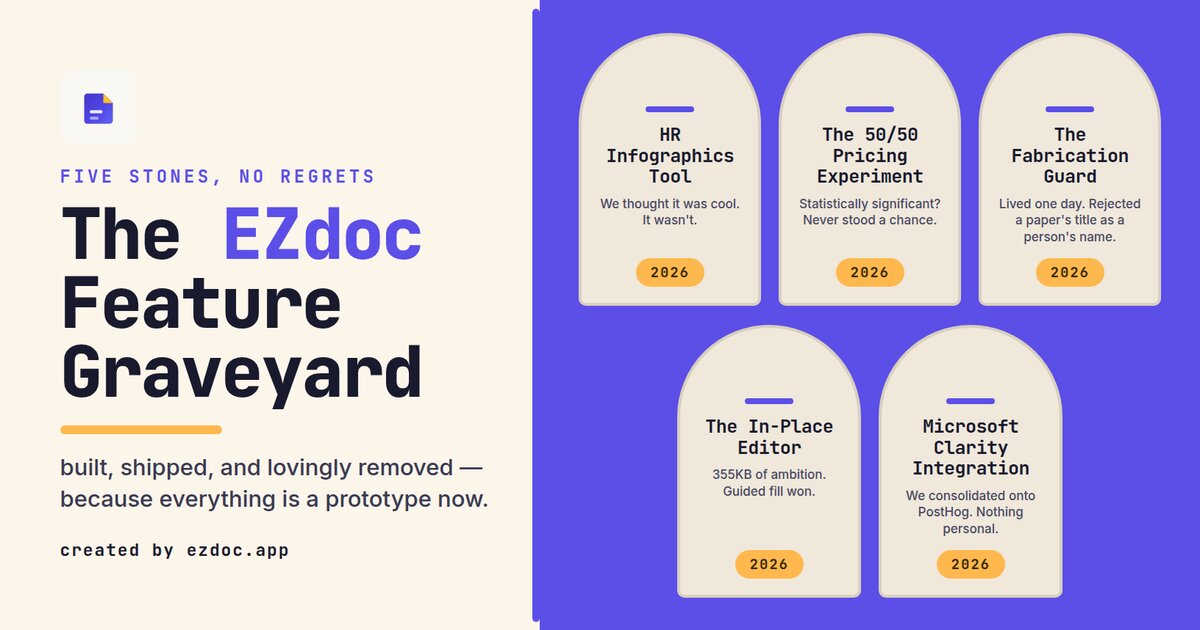
Don't believe me? Here's our actual feature graveyard — five things we built, shipped, and deleted this year:
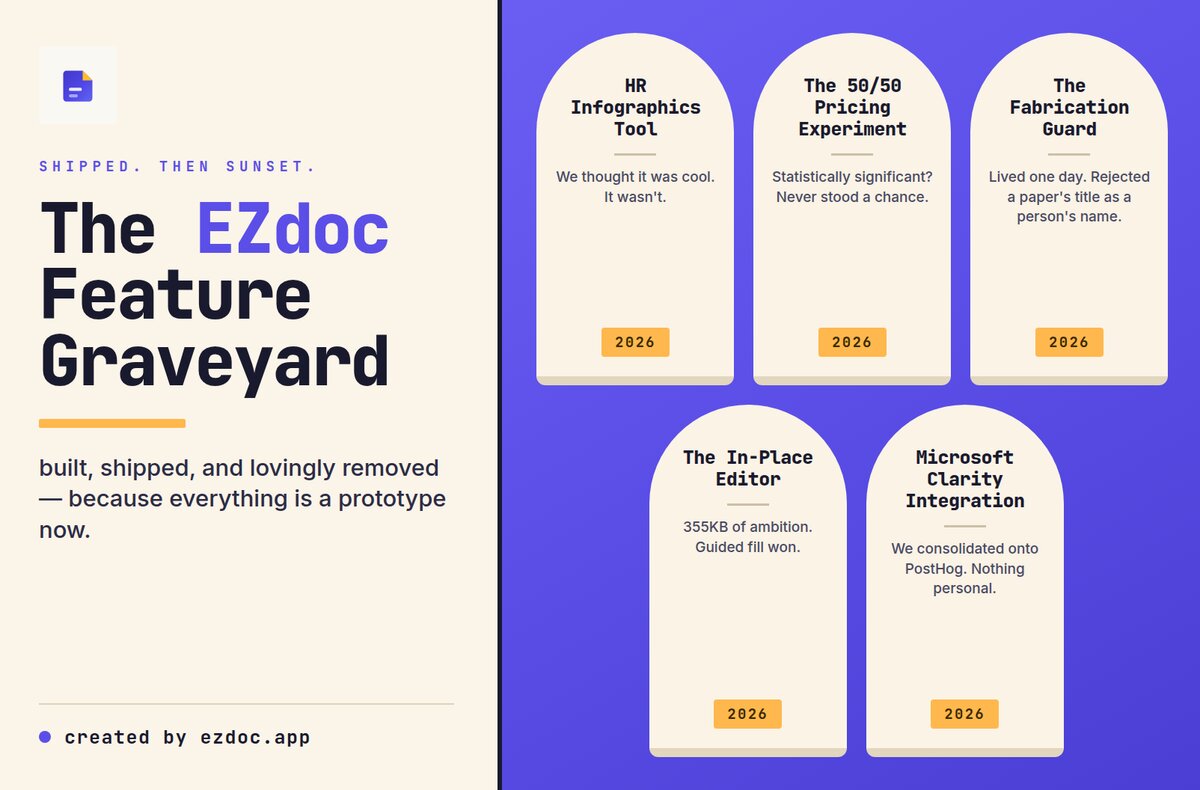
Three stories from the graveyard
The HR Infographics Tool. I thought it was cool. Shipped it, watched it, and it just... didn't land. It didn't fit with everything else we'd made, and it wasn't adding real value for the people using the product. So I removed it. That was the whole decision — no post-mortem, no grief over the hours, no "but we already built it" meeting. It existed, it taught us something, and then it was gone.
The 50/50 Pricing Experiment. We built a full live A/B price test. And building it was cheap enough that we could step back and ask the honest question: is this experiment even worth running? It wasn't — at our volume it could never reach significance. Deleted. We learned the answer to a question we didn't even know we should be asking, and it cost us almost nothing. (We've made bigger pricing calls with the same spirit — we once killed feature-gated pricing entirely when it stopped making sense.)
The Fabrication Guard — my favorite. We shipped a safety feature that hard-failed any document generation that drifted from the user's source material. Sounded responsible. Within its first day it was rejecting perfectly good documents — it thought a paper's title was a person's name. We pulled it within 24 hours and shipped a better answer. Nobody had to defend the sunk cost. The removal was the quality improvement.
Building is playful again
It's honestly one of my favorite things about where we are right now. Building feels less like defusing a bomb and more like testing noodles — throwing them at the wall and seeing what sticks. The stakes of any single throw dropped, which means you get to throw more. More ideas, more swings, more chances to find the thing that actually helps someone.
And here's the part people don't talk about enough: this is better for the people we build for, not just for us. When iteration is cheap, you can finally listen properly. Someone says "this almost works for me, except..." and instead of a backlog ticket that never moves, you can respond. Same week. Sometimes same day. Empathy stops being a value on a wall and becomes a loop you can actually run.
The craft now isn't in the building. It's in the seeing — what's landing, who it's helping, when to double down and when to let something go. Judgment is the new bottleneck, not engineering.
A confession, in the form of a greeting card
When we deleted the HR infographics tool, the AI generated a farewell card for it. Unprompted.
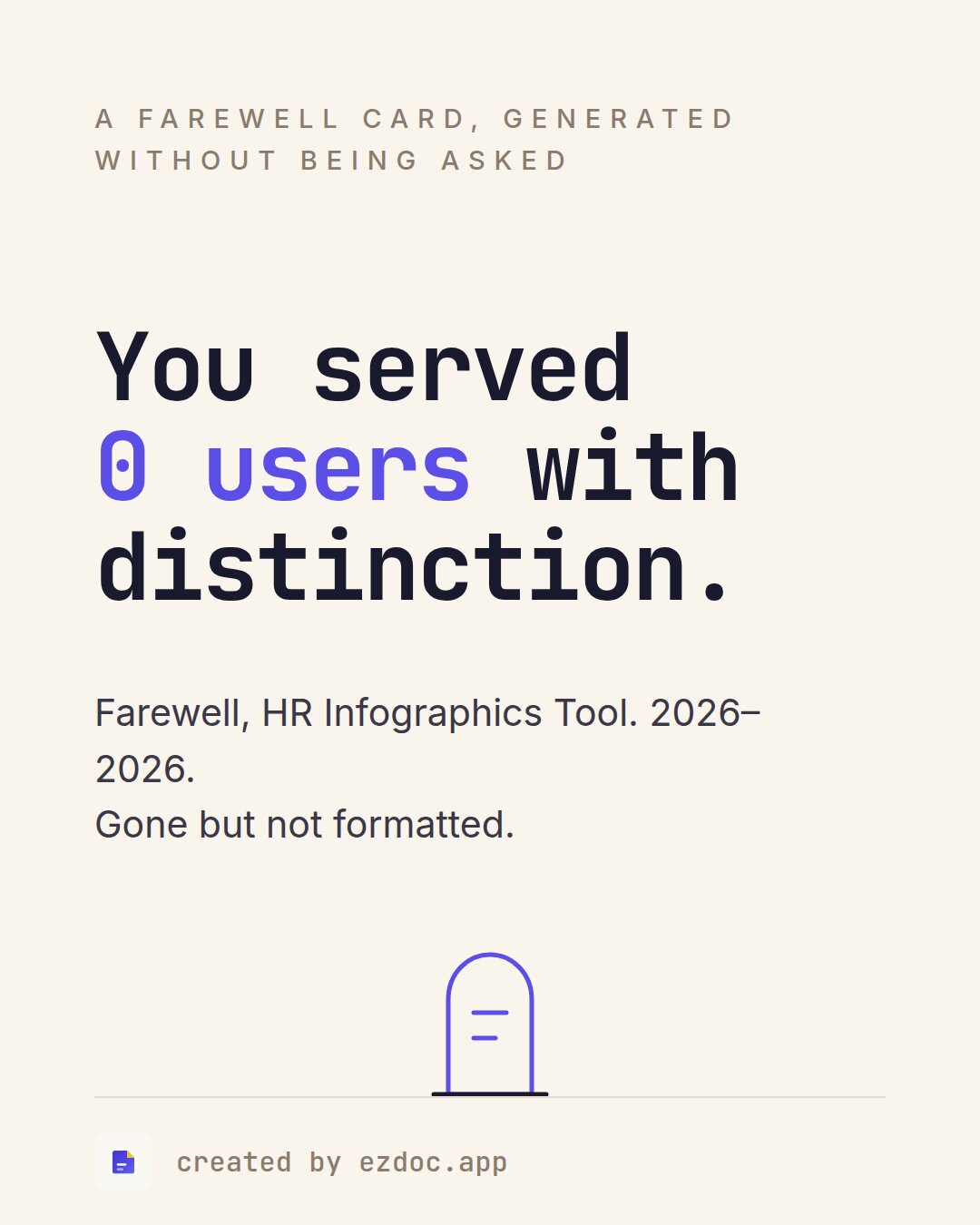
We kept the card. We still deleted the tool.
That, to me, is 2026 in a nutshell: the artifacts are so cheap that even the jokes are production-quality. (Both images in this post are EZdoc flyers, made in about the time it took to write the paragraphs around them — we build flyers in about thirty seconds around here. No designer, no Figma, no backlog ticket. That's the point.)
So what's in your graveyard?
My advice, if you're sitting on an idea: stop protecting it. Build the scrappy version this week. Ship it small. Watch what happens. The wall doesn't care how many noodles you throw at it — and right now, noodles are basically free.
And if you want a head start on the "ship something today" part — making a flyer, poster, or one-pager in EZdoc takes about thirty seconds. Describe it, download it, get back to your idea.
Frequently asked questions
Isn't shipping half-baked things reckless?
Only if you skip the judgment part. Cheap prototypes mean more ideas surface — including bad ones. What makes that safe is a fast, honest review loop: ship small, watch real usage, and be genuinely willing to delete. Every feature in our graveyard was reviewed, measured, and removed on purpose.
How do you know when to kill a feature versus keep iterating?
I ask two questions: is it adding real value for the people using the product, and does it fit with everything else we're building? If either answer is no, it goes. The pricing experiment is the cleanest example — the data said the test itself couldn't produce a meaningful answer, so keeping it was pure cost.
What about the sunk cost of building something you delete?
That's the old physics talking. When a prototype costs an afternoon instead of a quarter, deletion stops being a loss and becomes a tuition payment — cheap, fast, and permanent as a lesson.
Doesn't AI-generated output need heavy review?
Yes — and that's the job now. We once had an AI assistant draft a "payment details" intake card, a concept that doesn't exist anywhere in our product. Review caught it before it ever touched a user, we rolled it back, and we wrote a permanent rule into our engineering docs so it never comes back. Generation is nearly free; judgment is the whole craft.
Where should I start if I've been sitting on an idea?
Pick the smallest version that a real person could react to, and build that this week. Not the full product — the noodle you throw at the wall. If even that feels heavy, that's usually a sign the idea needs shrinking, not more planning.